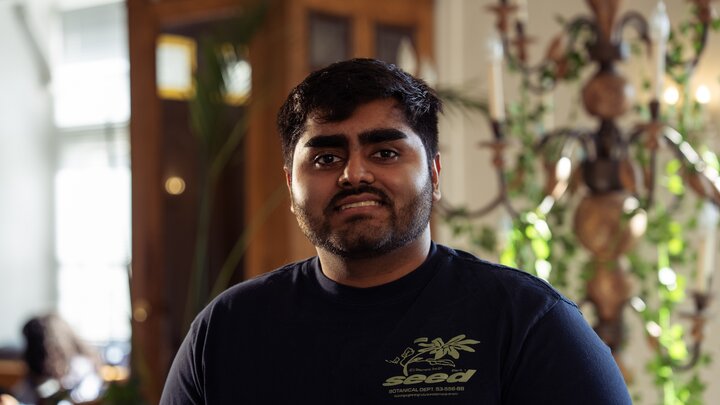
Vatsal Pandya came to the University of Nebraska–Lincoln at age 18 as an international student from Mumbai, India, with a plan to pursue big opportunities through his education. Thanks to his college courses, internship experiences, and personal drive, he’s managed to become the CEO of his own company before receiving his diploma.
Pandya is the founder and CEO of TasksMind, a technology company using artificial intelligence to eliminate on-call demand and fatigue for software engineers. Together with his fellow School of Computing students and co-founders Kashish Syed and Thang Do, whom he met through international student networks and internships, Pandya aims to change both workplace processes and cultures within the technology industry.
“If you get paged at 2 a.m. because something went wrong and you already worked 9 to 5, you're not getting paid extra, but you carry that burden to work extra,” Pandya said. “No one wants to wake up at 2 a.m. and open a laptop. Engineers are human, so we want to keep the production systems alive, but let the engineers sleep.”
TasksMind is uniquely designed to handle the entire lifecycle of a typical on-call software engineering task request from start to finish. Once TasksMind receives an alert, it investigates the problem, gathers context across repositories and logs, proposes a fix, tests it, and opens a clean pull request. Unlike many bots, TasksMind was specifically created for execution within production environments and has the ability to act rather than simply advise.
“If you ask ChatGPT to help you, it will give you a solution, but it wouldn't be accurate to your text stack, your company, or your code base, since it really differs from general knowledge to actual core knowledge,” Pandya said. “That's the biggest differentiator for us. We are not building another AI agent. Everybody's building AI agents, but ours has a specific niche for on-call work.”
Pandya said his idea for the company was shaped by his own experiences during his five internships. At each one, he repeatedly observed a consistent issue: When production systems failed, one on-call engineer was often left responsible for late-night troubleshooting and applying fixes under pressure.
Suspecting this problem was widespread and seeking an innovative solution, Pandya conducted more than one hundred interviews with engineers working across multiple teams at Amazon Web Services and mid-sized technology companies. The patterns were clear: on-call work almost always followed a predictable series of steps, yet it remained mostly manual.
Pandya believed the solution was just as clear: build an AI tool that offloaded these tasks to autonomous agents capable of completing such operational work.
“You're not implementing features at 2 a.m. You're making sure the systems are working or fixing whatever went wrong. It’s execution stuff,” Pandya said. “I thought, why not replace it with AI agents? They'll do all that for you and actually get it done.”
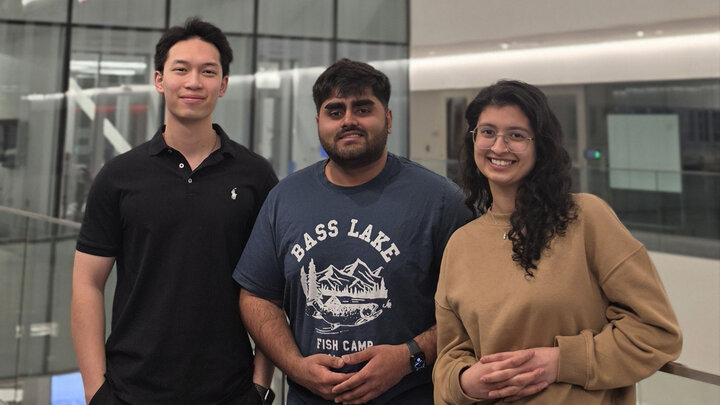
As Pandya began work on the company, he was invited to participate in the highly selective Dedalus Labs Break In program, a 3-week intensive residency in San Francisco that brings together founders, investors, and mentors to help launch and support new AI-based startup companies. Pandya was one of 20 participants selected out of more than 450 applicants. During the residency, he had a chance to pitch TasksMind to more than 20 investors and eventually secured financial backing and support from Forum Ventures and NVIDIA Inception. To date, the TasksMind team has now raised close to half a million dollars in funding to grow the company.
“It really boosted my confidence,” Pandya said. “We found our niche and what we need to work on, and I found my connections. So when I go back in May full time, I’ll already know people who are in the ecosystem and mentors who have been through the problems of a first-time founder.”
Pandya, a data science major, said his experiences both inside and outside of the classroom at Nebraska prepared him well for his future in tech. He said his professors who encouraged students to embrace AI and learn to use it to their advantage ultimately helped him develop the concept and vision for TasksMind.
“The professors don’t say, ‘Don't use AI.’ They say, ‘Once you’re working, you’re not going to be typing one-by-one lines. You're going to use Cursor and Claude Code, so do your projects with those tools,’” Pandya said. “I really loved that encouragement to use AI products, but also learn not to fully rely on them, and make sure you actually know what you’re doing.”
Pandya is preparing to graduate from the University of Nebraska–Lincoln in May, then relocate to San Francisco full time to continue to build the company alongside his co-founders. Pandya said that while the team could have chosen to pursue safer, conventional employment paths after graduation, they instead made a collective decision to fully commit to TasksMind.
“Going all in is the biggest thing required in a startup, because you cannot be working 9 to 5 and building a startup. It requires your full attention,” Pandya said. “I feel like the people working with me are all in and also truly believe in the mission.”
Pandya is certainly all in on TasksMind, having received and passed on a major opportunity this past March. In what he described as a “full-circle moment,” he received an email from the company that was once his dream employer: Apple. He was invited to interview for an internship he’d applied for eight months prior, before he’d even begun working on TasksMind. Pandya said he appreciated the offer and considered the timing of it perfect.
“If Apple had replied earlier, my life would probably look completely different, because I would’ve said yes immediately,” Pandya said. “At that point, I was still trying to get picked, but by the time they replied, I had already gone from applying for opportunities to building my own company. A delayed opportunity doesn’t always mean you missed out. Sometimes it means you were meant to build your own.”