CodeLNK hosted its annual Hour of Code and Interactive Tech Fair event on Saturday, Dec. 6, at Nebraska Innovation Campus with approximately 500 participants in attendance.
Hour of Code is a global initiative to introduce computer science to K-12 students through local events across the world. Lincoln’s Hour of Code included a morning full of fun coding activities for all learning levels and an interactive tech fair. This year’s tech fair featured more than a dozen technology-focused booths offering interactive and educational demonstrations.
The University of Nebraska–Lincoln’s School of Computing has been a leader in promoting computing initiatives and Hour of Code in the state of Nebraska for more than a decade.
“The School of Computing has proudly supported this event for many years,” said School of Computing Director and Professor Witawas Srisa-an. “We aim to inspire young learners and their parents by highlighting the importance of computing and its role in solving real-world problems. Together, we ignite creativity—one program at a time.”
This year, several School of Computing faculty, students, and lab members also participated in Hour of Code and Interactive Tech Fair by hosting booths and leading activities featuring drones, robots, and virtual reality activities. Participants included:
• Assistant Professor Robert Dyer
• Charles Bessey Professor and Senior Associate Director Leen-Kiat Soh
• Dale M. Jensen Chair Professor Mehmet Can Vuran and the Cyber-Physical Networking (CPN) Lab
• Associate Professor Bonita Sharif and the Software Engineering Research and Empirical Studies Lab (SERESL)
• Associate Professor Hongfeng Yu and the Visualization Lab
• The NIMBUS Lab team
• Assistant Professor of Practice Jeff Falkinburg and the Husker STEM VR and Career Explore XR Senior Design teams
Soh is a co-founder of the local organization CodeLNK, dedicated to promoting K-12 computer science education and participation in the Lincoln community. The group consists of members from K-12 schools, post-secondary institutions, and the local tech industry. Hour of Code is the group’s biggest event of the year, held in partnership with the Lincoln Chamber of Commerce, several local tech companies and employees, academic representatives from the School of Computing and UNL’s Teaching, Learning, and Teacher Education Department, the Computer Science Teachers Association (CSTA) Huskers chapter, Lincoln Public Schools, and Nebraska Innovation Campus. CodeLNK has continued to organize the event every year (with the exception of two years due to COVID-19) since its founding in 2015.
“This event has exposed not just young learners but also their parents to computing and its important roles in problem solving, from computational thinking to computing to Artificial Intelligence (AI), with applications in the humanities, arts, sciences, and technologies.” Soh said. “In today’s world, students who can more effectively practice computational thinking with strong computing skills will be able to better leverage advances in AI to solve a broad range of real-world problems.”
Sheila Foley, a doctoral student in the School of Computing, volunteered to participate in this year’s event with Girls Code Lincoln, a local nonprofit dedicated to educating young women about technology through creative initiatives. She said the event is a great way to introduce students to technology tools and computing concepts while having fun.
“These events give kids a chance to learn through hands-on activities, such as wiring a circuit to make a firefly light up or experiencing virtual reality. The research lab demos from university students are also great to show kids such a wide range of what is possible to do with technology,” Foley said. “I enjoy participating in outreach events like this one because I enjoy seeing the excitement and enthusiasm kids have around computing.”
by Victoria Grdina
December 11, 2025
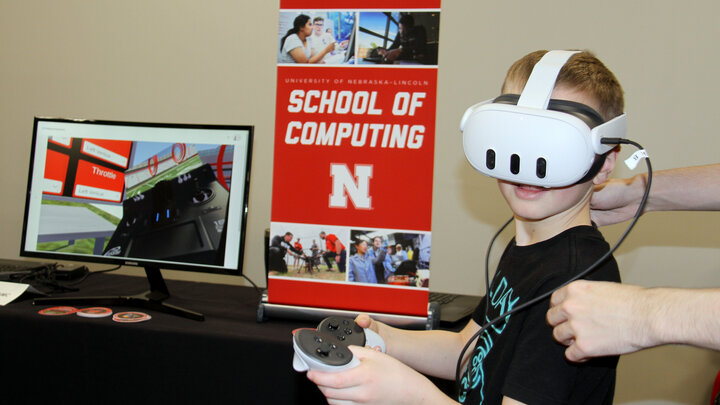
A young student plays a VR game at Hour of Code 2025.
Leen-Kiat Soh