As the advancement of artificial intelligence continues to revolutionize various fields of science, technology, and modern daily life, it presents a vast range of innovation possibilities and solutions to societal challenges. However, most artificial intelligence systems also require powerful computers and large amounts of energy to operate, limiting usage and creating additional challenges.
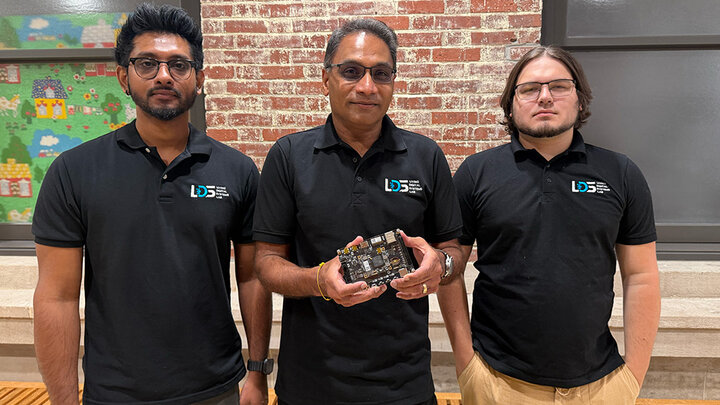
With a 3-year National Science Foundation Future CoRe grant in the amount of $782,358, School of Computing Associate Professor Sasitharan Balasubramaniam is exploring a new, alternative approach to intelligent computing inspired by bacteria.
While bacteria do not possess brains or nervous systems, they still possess the capabilities to sense their surroundings, process information, adapt to changing conditions, and even make decisions crucial to their survival. They’re also able to perform these functions with remarkable resilience and energy efficiency, making them an ideal prototype for an intelligent computational framework.
“Normally when we think of AI and AI models, they’re inspired by neuroscience and the way neurons are connected to each other in the brain,” Balasubramaniam said. “We forget that there are also other organisms that are adaptive, and they have quite clever ways of withstanding harsh environments and making various different types of decisions.”
Bacteria operate using gene regulatory networks, interconnected control systems that turn genes on or off in response to internal and external signals. Balasubramaniam and his research team aim to analyze and develop a new artificial intelligence architecture inspired from gene regulation called “artificial non-neuronal networks.”
“By studying the key gene regulation process in bacteria, we may be able to understand how they adapt and perform with such a little amount of energy, which we can then adapt to create this AI architecture that consumes a low quantity of energy,” Balasubramaniam said. “It can hopefully lead to a new form of an AI architecture that is very lightweight and very energy efficient.”
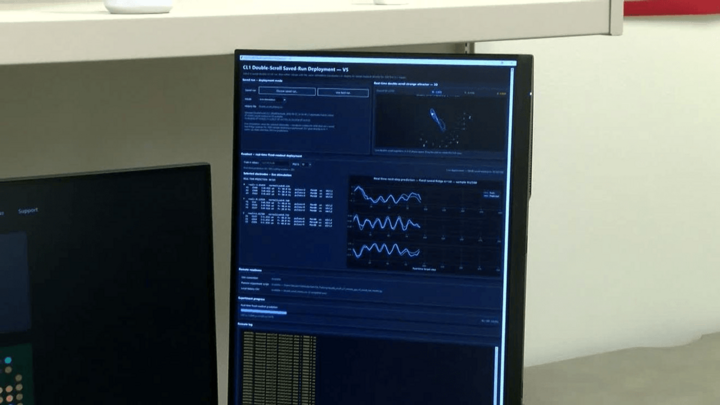
To develop this framework, Balasubramaniam and his research team will first explore the fundamental mechanisms that enable information processing, context perception, and memory function in bacterial gene regulatory networks. Using their findings, they’ll develop mathematical models and algorithms to construct their artificial non-neuronal network architecture for edge computing and AI applications. Once the architecture is established, they’ll develop software tools for deployment on field-programmable gate arrays (FPGAs), integrated circuits designed to be repeatedly re-programmed and customized. Finally, they’ll test the software against benchmarks measuring performance, scalability, memory usage, and efficiency to evaluate their framework’s functionality.
"Our preliminary results suggest that we can achieve higher computational performance using only a tiny fraction of the parameters required by a conventional artificial neural network,” said Samitha Somathilaka, a postdoctoral researcher on Balasubramaniam’s team. “In one example, the conventional network required more than ten thousand parameters, while our approach achieved a lower prediction error with just 15 parameters, roughly 690 times fewer. That dramatic reduction points toward much more compact and potentially energy-efficient computing systems."
Reducing the required amount of energy and network size would expand usage opportunities into areas where most current artificial intelligence systems are impractical or unusable, such as in very small devices or energy-constrained settings.
“With our architecture being more energy efficient, we might be able to scale the device down even further. We’ll also need to reduce the energy source because the amount of power it's going to consume is hopefully going to be so small,” Balasubramaniam said. “We're hoping that this brings edge computing applications to even more miniature devices.”
Enabling intelligent systems in miniature devices such as sensors, wearables, and remote monitoring systems could also expand innovation opportunities in multiple fields. By reducing dependence on high-powered remote computers to run or recharge, these systems could support autonomous robots, environmental and agricultural sensors, health-monitoring technologies, and implantable devices.
“The longevity of the actual device might be longer than the devices that are currently available today, so that means that the application might also change,” Balasubramaniam said. “You might be able to let a device live inside an environment, such as the body or soil, for a much longer period to collect more data, rather than having to take it out with the amount of data that you have available since the power has run out.”
Balasubramaniam believes that this research will not only lead to new advancements in AI technology, but could also potentially transform the field of AI as a whole.
“The most exciting thing is that we are now expanding the definition of AI, where traditionally we have relied on inspiration from neuroscience,” Balasubramaniam said. “We feel that this could create a new trend in AI, where researchers will look at other organisms for inspiration to develop novel algorithms and open up new application opportunities.”